
by Craig Fisher
If your job posts get traffic but applications are quietly disappearing, AI just decided you don’t exist.
Apply rates are up 35%. AI adoption among candidates hit 70%. Google’s AI Overviews now appear in over 13% of searches. The data isn’t ambiguous—the shift has already happened.
While TA teams obsess over clicks and job board spend, candidates have already moved on—asking ChatGPT, Perplexity, and Claude which companies to apply to. And these AI systems aren’t seeing your jobs.
This is the AISO problem. And it’s bigger than most talent leaders realize.
The Shift Nobody’s Talking About
The way candidates find jobs has fundamentally changed:
Conversational queries to AI tools now dominate job search behavior. AI Overviews appear in nearly half of Google searches. ChatGPT, Perplexity, and Claude have become primary career advisors. Meanwhile, 70% of global employers are using AI in recruitment—but only on the hiring side.
Here’s what most TA teams miss: While you optimized for Google’s algorithm, candidates started asking AI systems to summarize your company, rewrite your job descriptions, and recommend whether they should even apply.
If your employer data isn’t structured for AI interpretation, you’re not losing rank. You’re losing relevance.
That’s not an SEO problem. That’s an AISO problem.
What Is AISO?
AISO™ (AI Search Optimization) is the practice of structuring employer brand, job data, and career-site signals so AI-driven systems can accurately retrieve, summarize, and recommend your opportunities to candidates.
Think of it this way:
- SEO helped candidates find your jobs in search engines
- AISO determines whether your jobs even exist in AI-mediated discovery
Three concrete examples of AISO in action:
1. When a candidate asks ChatGPT “What companies are hiring software engineers in Austin with strong work-life balance?”—does your company appear in that answer? That’s AISO.
2. When Perplexity summarizes “Best entry-level marketing roles for recent graduates”—do your open positions get cited? That’s AISO.
3. When Claude generates “Companies known for great benefits in healthcare”—is your EVP part of that response? That’s AISO.
Most employers don’t show up in any of these scenarios. Not because their jobs aren’t competitive. But because their signals aren’t interpretable.
Why SEO Alone Is No Longer Enough
For years, recruitment marketing optimization meant keywords, job boards, click-through rates, cost per apply, and search rankings.
That world assumed a human was typing a query, scanning results, and clicking a link.
That’s no longer the dominant behavior.
Today, AI systems don’t just index pages. They synthesize information, compare sources, infer intent, filter credibility, and compress complexity into answers.
This means employers are no longer competing only on keywords, spend, and volume. They’re competing on signal clarity, data consistency, brand trust, structural readability, and machine-level comprehension.
This is not about gaming algorithms. It’s about being understood.
The Terminology Debate (And Why It Matters)
You might have heard terms like AEO (Answer Engine Optimization) or GEO (Generative Engine Optimization). Here’s why AISO is different—and more durable.
In a recent conversation with David Armano and Patrick Rooney, we unpacked something many practitioners are feeling but haven’t articulated yet: The industry is struggling to name what’s actually happening.
The limits of AEO and GEO:
AEO frames AI as an “answer engine” that responds to questions. But AI isn’t just answering—it’s anticipating intent, making recommendations, filtering options, and acting as an intermediary. Reducing AI to an answer engine understates its role.
GEO focuses on how large language models generate responses. But it’s anchored to today’s technology—generative AI. What about retrieval systems, recommendation engines, embedded copilots, and agentic workflows? Optimizing only for generative output risks chasing the current interface instead of the underlying system behavior.
Why AISO endures:
AISO doesn’t assume a specific interface, interaction pattern, or AI modality. It focuses on something more fundamental: how AI-driven systems interpret, prioritize, and recommend information in response to human intent.
That includes search, discovery, comparison, summarization, recommendation, and prediction—across whatever interface emerges next.
AISO isn’t about optimizing for answers or engines. It’s about optimizing for understanding.
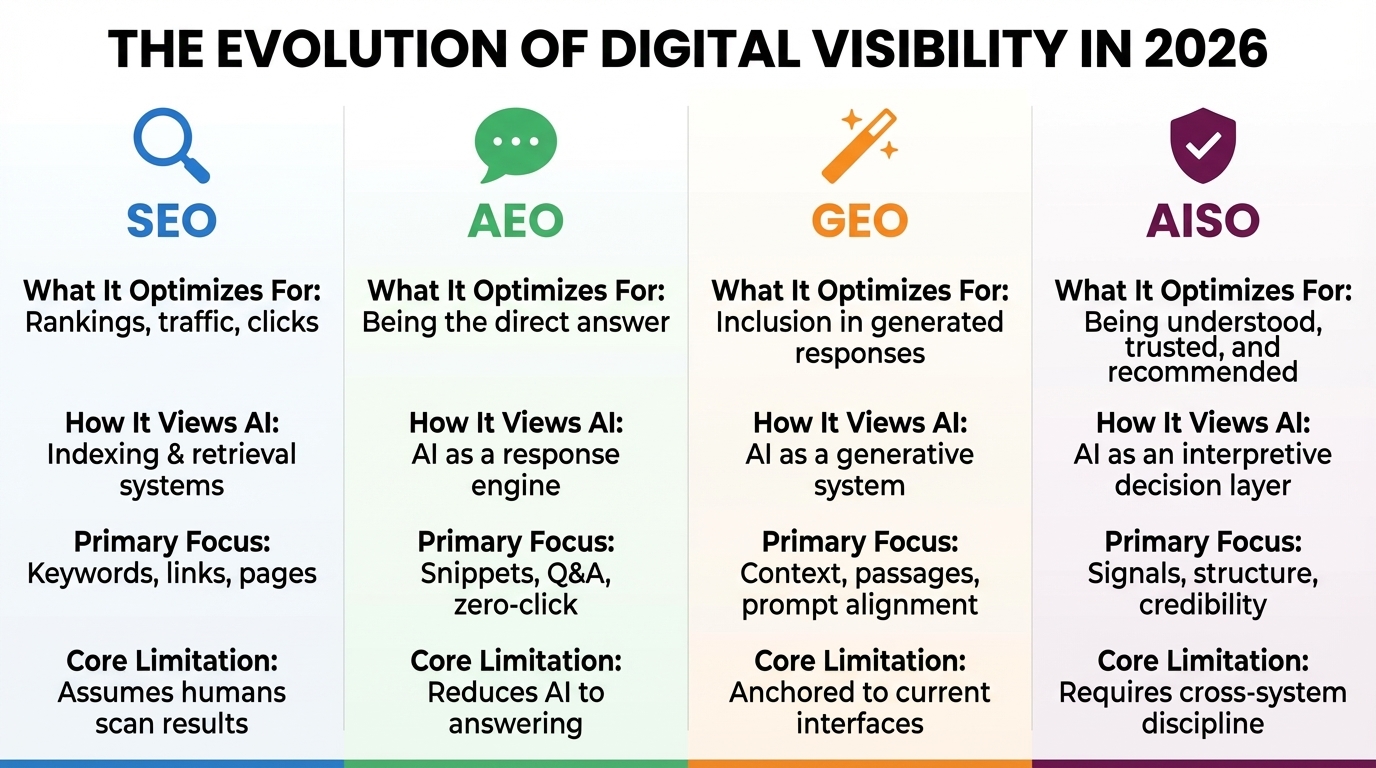
This evolution mirrors what happened with “social media optimization” becoming digital ecosystems, “mobile-first” becoming experience-first, and “SEO” becoming search experience design.
Early terms describe the surface behavior. Enduring frameworks describe the system beneath it.
That’s why PESO lasted. And that’s why AISO has staying power.
The Five Pillars of AISO
AISO lives at the intersection of five areas employers already touch—but rarely align:
1. Job Data Integrity
AI can’t interpret inconsistent titles like “Sales Guru” or “Marketing Ninja.” Titles, locations, compensation, requirements, and taxonomy must be clean, consistent, and machine-readable.
Action: Standardize titles to industry-recognized roles. Use O*NET classifications as your taxonomy baseline.
2. Career-Site Structure
Schema markup, metadata, internal linking, and content hierarchy determine whether AI can interpret your roles accurately. Schema markup tells AI what your pages actually mean.
Action: Implement Organization, JobPosting, and FAQPage schema. Use Google’s Rich Results Test to validate implementation.
3. Employer Brand Signals
Reviews, reputation, DEI language, EVP clarity, and consistency across platforms matter more than ever. AI pulls from reviews, social signals, and public content to form opinions about your company.
Action: Audit what appears when you search “[Your Company] culture” or “[Your Company] employee reviews.” That’s what AI is reading.
4. ATS & Feed Hygiene
AI consumes what your systems emit. Messy data inputs create distorted AI outputs. Messy inputs produce distorted outputs.
Action: Review your XML feeds—do job titles match? Are locations standardized? Common issue: the same role posted 15 times with different titles.
5. Candidate Intent Matching
AI doesn’t just surface jobs—it predicts fit. If your signals are vague, you won’t be recommended. AI predicts fit based on signals, not just keywords.
Action: Include explicit information about remote flexibility, growth paths, and team structure. AI can’t infer what you don’t state clearly.
The companies AI recommends aren’t necessarily the best employers. They’re the most interpretable employers.
Why AISO Feels Like PESO Did in the Early Days
Every few years, a framework comes along that doesn’t just explain what’s happening—it gives the market language for what it already feels.
For PR and communications, that framework was the PESO Model, popularized by Gini Dietrich. It didn’t invent paid, earned, shared, or owned media—it organized them into a system people could teach, sell, and build strategy around.
(Gini just published an excellent piece on how the PESO Model has evolved for 2026—worth reading alongside this.)
In talent acquisition and recruitment marketing, we’re standing at a similar inflection point.
Here’s why AISO feels like PESO did in 2014:
Gini didn’t invent paid, earned, shared, or owned media. She gave practitioners shared language for what they were already doing—and that language became the industry standard.
AISO does the same for talent teams facing AI disruption.
The PESO Model succeeded because it gave practitioners shared language, created a teachable framework, unified fragmented activity, and elevated strategy over tactics.
AISO does the same thing for talent teams navigating AI disruption.
Right now, TA leaders are:
- Experimenting without a map
- Chasing tools instead of principles
- Confusing automation with optimization
- Treating AI as a channel instead of an interpreter
AISO provides the structure they need.
Like PESO, AISO is:
- Early — Most teams don’t know this matters yet
- Necessary — The shift is already happening
- Teachable — It’s a framework, not rocket science
- Inevitable — AI-mediated hiring is the future
PESO organized channels. AISO organizes meaning.
And the teams who understand AISO first won’t just adapt—they’ll define the standard others follow.
That’s how frameworks are born.
So, Is AISO the New PESO?
Not exactly.
PESO organized channels.
AISO organizes meaning.
But like PESO, AISO is early, necessary, teachable, and inevitable.
The difference is profound: while PESO helped practitioners coordinate where and how they communicated, AISO helps employers ensure they can be understood, trusted, and recommended by the AI systems that now mediate candidate discovery.
PESO organized channels. AISO organizes meaning.
And meaning is what matters when machines decide who gets seen.
The Real Opportunity (and the Warning)
Here’s the hard truth:
AI is rapidly becoming the primary career intermediary, and many TA teams are still building their response strategy.
Those who define their signals, structure their data, align brand and job reality, and design for interpretation rather than clicks will become the employers AI recommends.
Those who don’t will wonder why “traffic looks fine” but applications quietly disappear.
The Practical Path Forward
If you’re a TA leader reading this and thinking “Okay, but where do I start?”—here are three moves you can make this quarter:
Immediate (This Week):
- Ask ChatGPT, Claude, and Perplexity about your company and open roles
- Document what they say (or don’t say)
- Share the results with your recruitment marketing team
Short-term (This Month):
- Audit your top 10 job postings for AI readability—are titles clear? Is remote status explicit?
- Implement basic schema markup on your careers page
- Ensure your ATS feed uses consistent taxonomy
Medium-term (This Quarter):
- Map your EVP to natural language candidate queries
- Create FAQ content that answers the questions AI gets asked
- Start tracking: “When someone asks AI about [your company], what gets cited?”
The good news? You don’t need a complete overhaul. You need a systematic approach.
That’s what AISO provides—a framework to organize the work you’re probably already doing, but disconnected.
Want to Go Deeper? The Complete AISO Resource Library
I’ve been researching and building AISO strategies with employers for months. If you want the full picture, here’s where to go next:
📊 For the data and market evidence: Read How AI Search Engines Decide Who Sees Your Jobs—this breaks down the Appcast benchmarks, adoption statistics, investment trends, and the 10 ways AI is revolutionizing job advertising right now.
🛠️ For the tactical playbook: Read AI Search for Hiring: Get Seen, Cited, and Selected—this covers the two-signal framework (Information Gain + Credible Citations), specific content types that win, and a 30/60/90-day implementation plan.
📖 For the complete employer playbook: Download the AISO Employer Playbook (PDF)—a practical guide you can share with your team today.
Join the Conversation in Person
Over 25 years in talent acquisition, I’ve seen every trend come and go. This isn’t a trend—it’s a tectonic shift in how candidates discover opportunities.
I’m covering AISO implementation strategies at TalentNet Live 2026 in Austin on March 13th. We’ll workshop real job feeds, career sites, and employer brand signals—and fix them together live. No theory, just hands-on optimization. Learn more and register here.
And if you’re rethinking recruitment in the AI age more broadly, my book Hiring Humans: Attract, Convert, and Retain Top Talent in the Age of Automation covers the cultural and strategic mindset shift this moment requires—beyond just the technical optimization.
The Bottom Line
The AI revolution in hiring isn’t coming. It’s here.
Apply rates are up 35%. AI adoption among candidates hit 70%. Google’s AI Overviews now appear in over 13% of searches. The data isn’t ambiguous—the shift has already happened.
The question is whether you’ll be recommended or invisible.
AISO is how you make sure it’s the former.
Because when AI mediates discovery, PESO organized channels—but AISO organizes meaning.
And meaning is what decides who gets seen.