
By Craig Fisher, author of Hiring Humans and Paint Your Store
In my 2014 keynote at DFWSEM, social was a megaphone—post more, boost more, chase keywords. Now the feed is an answer: AI is the new search engine and ranks proof over puffery. My playbook for employers is simple—publish checkable evidence and you’ll rank with the generative models.
The labor market is cooling—but it isn’t collapsing. Unemployment ticked up to 4.3% (Aug 2025) — see BLS Employment Situation — while hiring momentum downshifted after revisions. Layoffs remain historically modest, yet job creation has slowed and search frictions are rising. Translation: fewer slam-dunk candidates, more “almost rights,” and growing pressure to prove your value proposition to experienced workers—even in a slowdown.
Under the hood, two forces matter most for talent leaders:
- Productivity is up (about +3.3% in Q2) — see BLS Productivity & Costs (Q2 2025, revised) — which helps margins but raises the bar for who you hire and how fast they add value.
- Wage growth is moderating but sticky (roughly 4.1% overall; ~4.4% for job-changers) — see the Atlanta Fed Wage Growth Tracker (Aug 2025) — so comp clarity and career narratives still decide offers.
Pipeline snapshot: Openings and quits have eased to more sustainable levels (quits ~2.0% in July) — see BLS JOLTS (July revisions) and JOLTS Table 4 (Quits rate) — and small businesses report the fewest “jobs they can’t fill” since 2020. The market is loosening—not loose.
Meanwhile, how candidates research you has changed fast. AI-mediated discovery is mainstream. A third of U.S. adults have used ChatGPT — see Pew Research Center (June 25, 2025). If you’re relying on an old career site and a press page, you’re playing 2019 ball in a 2025 league.
AISO vs GEO vs SEO — Quick Guide
• AISO (AI Search Optimization): For employers. Optimize evidence to be included in AI answers. Two signals: Information Gain + Credible Citations.
• GEO (Generative Engine Optimization): The umbrella. Structure content, schema, and provenance so generative engines can find, verify, and cite you.
• SEO (Search Engine Optimization): Traditional ranking for web search. Still vital for jobs/careers pages and evergreen content; complements AISO.
The Big Shift: “Get Seen, Cited, and Selected” by AI—Not Just Ranked by Google
In Paint Your Store, I argue your brand is a storefront: signage (messaging), shelves (content), and checkout (conversion). In 2025, there’s a new aisle between your audience and your store: AI answers. When someone asks, “Best employers for HVAC apprenticeships in Dallas?” or “Which healthcare systems give surgical nurses the most autonomy?”, AI systems assemble answers, vet sources, and cite what’s most helpful—not who stuffed the most keywords.
From auditing thousands of AI results and building AISO (AI Search Optimization) programs with employers and vendors, two signals consistently determine whether you’re seen, cited, and selected:
Signal #1 — Information Gain via Proprietary Content
- Proprietary Playbooks — Publish your way of working (e.g., “Our 90-Day Ramp Plan for ICU Nurses,” “How Our Tech Residency Works: Weeks 1–12,” “The 3-Gate Interview Framework”).
- Real-World Comparisons & Diaries — Measured trade-offs and observed outcomes (e.g., “We piloted four 12-hour shift patterns—here’s the retention and overtime impact.”).
- Hyper-Specific, Edge-Case FAQs — Direct answers to intent (visa categories, bidding rules, certification retries).
- Proof Pages & Cohort Case Studies — Timeline + baseline + intervention + results (e.g., “Reduced traveler spend 23% by cross-training 41 nurses in two quarters; satisfaction +0.4.”).
- Checklists that actually do the job — Pre-shift handoff, on-call playbooks—downloadable, versioned, maintained.
Why it wins: AI aims to deliver the most helpful answer. If your artifact uniquely clarifies reality, the model prefers it—even if your domain rating is modest.
Signal #2 — Third-Party Citations & Reputation Indicators
- Authoritative References — Neutral context anchors like Wikipedia and respected industry pages.
- Category Review Sites & Directories — For vendors: G2/Capterra/Trustpilot. For employers: Glassdoor, Indeed Company Pages, Great Place to Work, Magnet status, Leapfrog, U.S. News specialties, state boards, credible local media.
- Roundups & Expert Lists — Curated “best of” features become shorthand evidence in AI summaries.
- Podcast & Conference Mentions — Multi-format expert mentions (panels, journals, podcasts) feed transcripts and authority edges.
- Why spam fails — Models discount irrelevant or low-quality citations. A single accreditation or credible ranking can outweigh 200 directory links.
What Today’s Economy Demands From Talent Teams
- Design for “Day 1 to Day 90.” Hiring is only half the funnel. Publish and operationalize first-90-days playbooks by role (retention + AI-visible asset).
- Make compensation & progression legible. Ranges, differentials, bonus math, timelines.
- Prove it with maintained artifacts. If it’s not dated, versioned, and specific, it’s marketing. If it is, it’s evidence.
Your 30/60/90 AISO Plan (Employer Edition)
Days 1–30: Inventory questions; ship Role FAQs + First-90-Days pages; fix titles/ranges/shifts; publish one Proof Page.
Days 31–60: Two proprietary playbooks; one comparative diary; downloadable checklists.
Days 61–90: One authoritative external per role family; two curated inclusions; three expert mentions.
Measurement
- AI Share of Voice — % of targeted prompts where your org/artifacts are cited.
- Citation Quality Index — weight authoritative sources higher than generic directories.
- Funnel Lift — application→interview, 90-day retention, time-to-productivity deltas.
- Answer Coverage — % of top 50 candidate questions precisely answered.
Content Starters You Can Publish This Quarter
- How Our 90-Day Ramp Plan Makes New ICU Nurses Safer, Faster
- Shift Design Showdown: 4×10 vs 5×8 in Field Service
- Career Pathing for Surgical Techs: 18-Month Skill Map + Pay Progression
- Residency Cohort 2024—What Worked, What We Changed, What’s Next
- Visa & Licensure FAQ for Allied Health (TN, E-3, H-1B where applicable)
Recruiter Enablement: Make It Easy to Use the New Store
From Hiring Humans: the brand isn’t what we say—it’s what a recruiter can prove in 90 seconds. Ship a “Black Book” one-pager per role family: Why we win this candidate (3 bullets, proof-linked) • The Deal (range, schedule, differentials, OT policy) • Ramp & Coaching (milestones, tools) • Next Step (interview path + prep).
Why This Works Now
- The market isn’t flooded—it’s re-sorting.
- AI-mediated discovery is mainstream — see Pew Research.
- Productivity pressure favors rigor and faster ramp — see BLS Productivity (Q2 2025).
Where AISO Fits Inside GEO (Generative Engine Optimization)
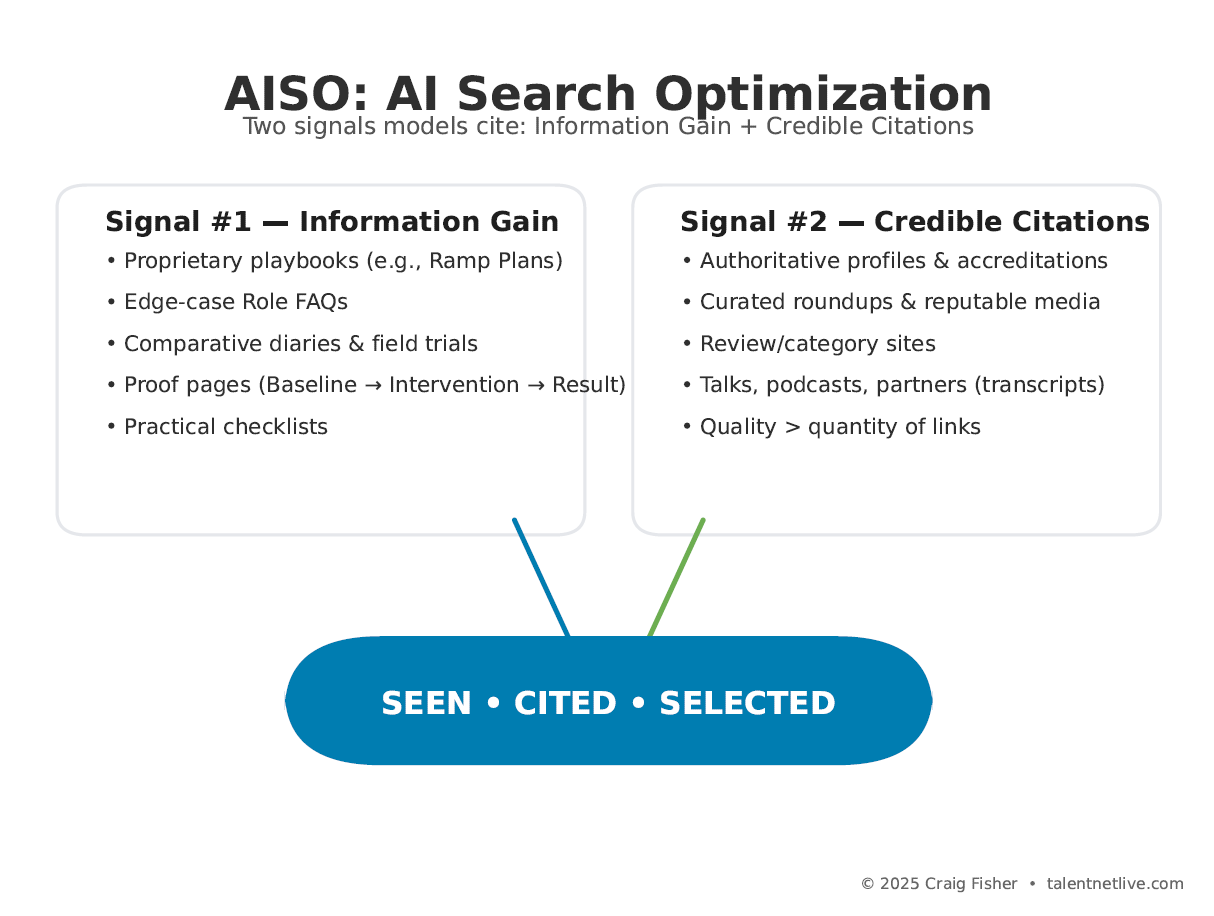
AISO is GEO applied to hiring. Generative Engine Optimization (GEO) is the broader practice of structuring evidence so generative AI can find, verify, and confidently include your brand in its answers; AISO narrows that to employer discovery and selection. In AISO, you win on two signals: Information Gain—publish proprietary, practical proof like first-90-days playbooks, edge-case role FAQs, comparative trials, and measurable outcomes—and Credible Citations—earn authoritative third-party corroboration (accreditations, reputable rankings, partner pages, reviews, and transcripted talks). Together, these signals make your company the “receipt” AI prefers to cite—and the one candidates trust.
Figure: AISO two-signal framework (Information Gain + Credible Citations → Seen, Cited, Selected)
Bottom Line
Stop optimizing for a blue link. Start optimizing to be the proof AI wants to include. Build proprietary, maintained, specific artifacts that create information gain—and earn credible third-party corroboration. Do that, and you won’t just rank; you’ll be seen, cited, and selected by both humans and the models advising them.
—Craig
You can download my AISO playbook for jobs and employers here.