
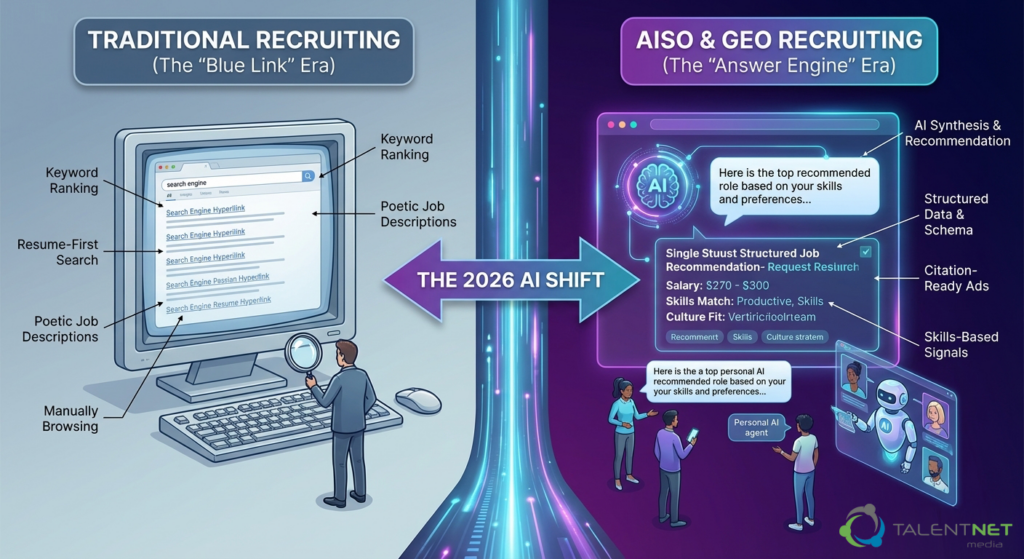
The AISO Era: How AI Search Optimization is Transforming Talent Acquisition in 2026
The rules of talent acquisition have been rewritten. In 2026, the intersection of AI Search Optimization (AISO) and Generative Engine Optimization (GEO) has fundamentally changed how candidates discover opportunities and how employers compete for visibility. For recruiters, success no longer means ranking on a job board—it means ensuring your opportunities are synthesized and recommended by the AI agents that candidates now use as their primary search interface.
The shift is measurable, immediate, and accelerating. Here’s what’s changed in the last six months and how to optimize your strategy for the “Answer Engine” era.
The Death of the Blue Link
Today’s job seeker doesn’t scroll through pages of listings. Instead, they ask their AI agent: “Find me a remote Product Manager role in Austin that pays over $160k and values work-life balance.” If your job ad isn’t optimized for these engines, it simply doesn’t exist in the candidate’s world.
This isn’t theoretical. The data proves the transformation is already here.
The Numbers Behind the Shift
Job Ad Performance & Costs Are Changing
Appcast’s 2025 Benchmark Report reveals a critical inflection point:
- Apply rates surged 35%, reaching 6.1%
- Cost per click (CPC) jumped 27%
- Cost per application (CPA) increased only 4.8%
- Average cost per hire: $851
Sources: Appcast Press Release | Full Benchmark Report
Translation: Clicks cost more, but conversions are improving. Better structured ads and optimized career sites deliver better conversion efficiency. Performance now matters more than volume.
AI Adoption Is Exploding—On Both Sides
Among employers:
- HR AI usage jumped from 26% to 43%
- 99% of hiring managers now use AI in hiring
- 98% report that AI improves efficiency
Sources: Insight Global 2025 AI in Hiring Report | Hero Hunt AI Year in Review
Among candidates:
- 53% of new hires used GenAI during their job search
- 70% of candidates use AI to research companies and apply
Source: HireTruffle AI Recruitment Statistics
Translation: The job ad sits in the middle, serving two audiences simultaneously—humans and AI. Both must be able to parse, understand, and act on your content.
Career Sites Still Anchor Recruiting
Where employers post jobs:
- Company career site: 82%
- Job boards: 78%
- Internal postings: 69%
- Social media: 68%
Source: HR.com / Eightfold AI Future of AI Report
Translation: Career sites remain the foundation—but AI now determines who sees them. Your site must be schema-rich, structured, fast-loading, and AI-readable.
Google Jobs & AI Overviews Are Redefining Visibility
The Google search landscape has fundamentally shifted:
- AI Overviews now appear on 13.1% of searches
- Click-through rates drop 47% when AI Overviews appear
- Some sites have lost up to 79% of organic traffic
- Google Jobs UI changes have reduced exposure space
Sources: Digital Bloom 2025 Organic Traffic Crisis Analysis | Jobboardly Google Jobs UX Impact Report
Translation: When AI intercepts the click, only structured, schema-rich job content survives. Traditional SEO tactics are no longer sufficient.
Indeed Feed & Schema Changes Prove the Trend
Indeed’s recent policy changes signal the industry direction:
- Indeed stopped accepting new third-party XML feeds
- Platforms must now adopt API and structured data standards
Sources: Job Board Doctor Analysis | Dstribute Indeed XML Implementation Guide
Translation: Feeds are no longer just technical plumbing—they’re strategic assets. Structured data isn’t optional; it’s the price of admission.
The Market Is Investing Billions
Investment in AI recruiting technology tells the story:
- AI recruiting tech funding: $661.5M → $1.1B
- AI recruiting market size: ~$708M → $1.39B
- AI in HR market: $8.16B → $30.8B
Sources: SmartRecruiters Recruitment Statistics | Research Nester AI Recruitment Market Report | Precedence Research AI in HR Market
Translation: This isn’t experimental. This is where the economy is going.
10 Ways AI is Revolutionizing Job Advertising in 2026
- The Rise of the “Intermediation Layer”
AI has evolved from task-assistant to intermediary. By the end of 2026, 40% of enterprise applications are expected to feature AI agents. This means candidates now interact with your brand’s AI before ever speaking to a human recruiter. Your digital first impression happens through an algorithm.
- From Keywords to “Citation-Ready” Ads
GEO (Generative Engine Optimization) requires job ads to be scannable by Large Language Models. Poetic “About Us” sections are out. Structured data and scannable lists are in. The goal: ensure AI “answer engines” can easily cite your roles as top recommendations when candidates query their agents.
- Fighting “Application Slop”
Personal AI agents now flood recruiting pipelines. LinkedIn processes 11,000 applications per minute—a 45% year-over-year increase. To maintain AISO visibility while preserving quality, ads must now include “human-only” signals or specific friction points that filter out automated bot submissions without deterring real candidates.
- The Compression of Entry-Level Roles
A massive shift has occurred in the last six months: traditional entry-level positions are declining. Because AI can handle basic administrative work, companies are shrinking junior roles and prioritizing “mid-level minimum” hires who can manage AI workflows rather than perform routine tasks.
- Death of the Resume-First Search
Traditional resume keywords are losing their power. In 2026, only 37% of employers trust resumes as reliable indicators of talent. AISO-optimized ads now emphasize skills-based assessments and verifiable portfolios rather than traditional CV keywords. Proof of ability trumps descriptions of experience.
- Job Boards as “Data Feeds,” Not Destinations
Job seekers no longer browse boards manually—they deploy their AI agents to scan them continuously. To stay discoverable, job ads must be technically optimized to feed into AI employment exchanges that match candidates based on deep competency data rather than surface-level keyword matching.
- The “Agent Manager” Role
A new high-status recruiting role has emerged: the Agent Manager. These professionals don’t manage human teams; they calibrate fleets of AI agents to ensure the company’s job ads are being correctly interpreted, prioritized, and promoted by external discovery engines. It’s recruiting strategy meets technical optimization.
- Replacing Adjectives with Outcomes
Feeding AI “inspirational” adjectives produces generic job descriptions that blend together. The latest trend is feeding AI concrete numbers and business-level results. Modern AISO ads define “success in month 12” with measurable outcomes, helping generative engines match for high-performers based on achievement patterns rather than buzzwords.
- Hyper-Personalized “Immersive” Ads
Job advertising is moving into multimodal AR/VR environments. AI-powered avatars now deliver personalized “realistic job previews” that help decrease candidate drop-off by building trust through transparency. Candidates can experience the role before applying, leading to better-qualified applicants.
- The Signal-to-Noise “Doom Loop”
Recruiters face a challenging cycle: candidates use AI to apply more frequently, leading employers to deploy more aggressive AI filters. The winners in 2026 focus on Signal Arbitration—using AI not just to process more applications, but to extract authentic, human-verified talent from the noise. Quality signals matter more than quantity.
The New Rules of Visibility
In the AISO era, success requires rethinking fundamental assumptions:
- Career sites are AI engines, not just information repositories
- Job posts are structured data assets, not marketing copy
- Visibility is controlled by AI, not search rankings alone
- Schema is strategy, not technical overhead
- Signal quality beats volume, every time
- Humans still matter—but only when your content successfully reaches them
The future belongs to leaders who can write compellingly for humans while structuring content that machines can parse, understand, and recommend. Learn more about how to get seen, cited, and selected in AI search.
What This Means for Your Recruiting Strategy
The convergence of rising costs, AI adoption, and changing discovery patterns creates both urgency and opportunity. Organizations that treat job ads as structured data assets, optimize career sites for AI readability, and focus on signal quality over application volume will capture disproportionate value in this new landscape.
The transformation isn’t coming—it’s already here. The question is whether you’re optimizing for it.
Want to dive deeper?
Download the AISO Employer Playbook: TalentNet Media AISO Playbook
Follow TalentNet Live for ongoing insights on AISO, GEO, and the future of recruiting.